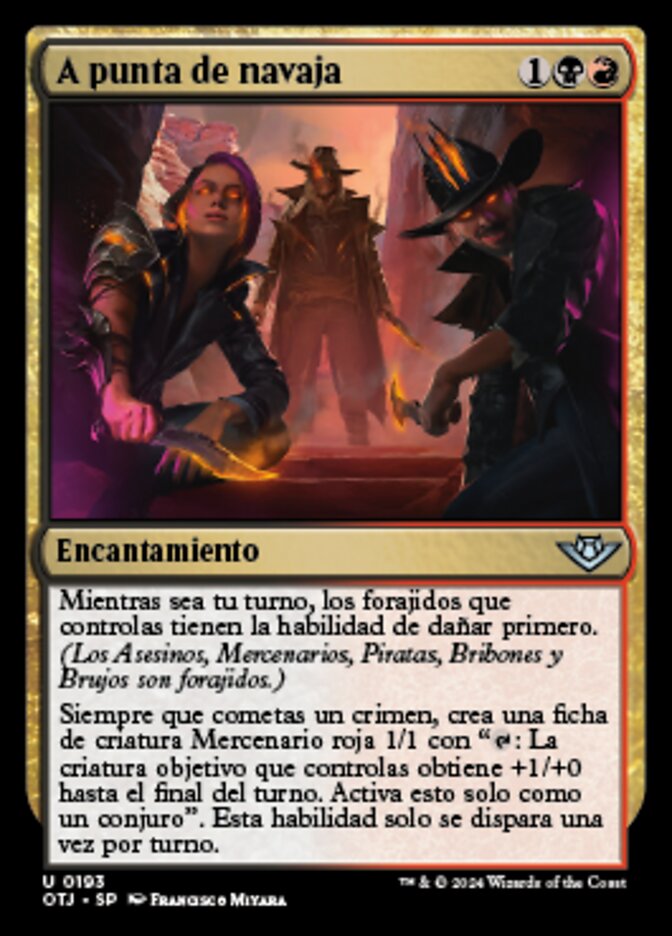
A punta de navaja (At Knifepoint)


 Valor de maná3TipoEncantamiento
Identidad de color Rakdos
RarezaInfrecuente
ExpansiónOutlaws of Thunder Junction (OTJ)
IlustradorFrancisco Miyara
Precio0,17 € · foil 0,26 € · 0,28 US$
Sobre esta carta
A punta de navaja es una carta de tipo encantamiento de Magic: The Gathering con valor de maná 3 (identidad de color: negro y rojo). Impresa en Outlaws of Thunder Junction (2024). Legal en Commander, Standard, Pioneer, Modern, Legacy y Vintage. Precio en Cardmarket: 0,17 €.
A punta de navaja
Siempre que cometas un crimen, crea una ficha de criatura Mercenario roja 1/1 con "
 : La criatura objetivo que controlas obtiene +1/+0 hasta el final del turno. Activa esto solo como un conjuro". Esta habilidad solo se dispara una vez por turno.
Texto de reglas (Oracle, inglés)
Whenever you commit a crime, create a 1/1 red Mercenary creature token with "
: Target creature you control gets +1/+0 until end of turn. Activate only as a sorcery." This ability triggers only once each turn.Nombre en cada idioma
Legalidad
Aclaraciones de reglas (en inglés)
2024-04-12
Creatures that deal first strike combat damage but lose first strike before regular combat damage is dealt won’t deal combat damage again unless they have double strike. This means you can’t have At Knifepoint leave the battlefield to have your outlaws deal combat damage twice in a turn.
2024-04-12
A card, spell, or permanent is an outlaw if it has the Assassin, Mercenary, Pirate, Rogue, or Warlock creature type. It doesn’t matter if it has more than one of those creature types; as long as it has at least one, it’s an outlaw.
2024-04-12
Outlaw is not a creature type. If an effect asks you to choose a creature type, you can’t choose outlaw.
2024-04-12
If an ability refers to an outlaw or whether a player controls an outlaw, it’s referring only to permanents with one or more of the creature types specified above. Notably, it’s not referring to any spell or card not on the battlefield. However, other abilities may refer to an “outlaw spell” or “outlaw card” in a zone other than the battlefield. Those abilities refer to spells and cards with one or more of the specified creature types.
2024-04-12
A player commits a crime as they cast a spell, activate an ability, or put a triggered ability on the stack that targets at least one opponent, at least one permanent, spell, or ability an opponent controls, and/or at least one card in an opponent’s graveyard.
2024-04-12
The spell or ability that constituted a crime doesn’t have to have resolved yet or at all. As soon as you’re finished casting the spell, activating the ability, or putting the triggered ability on the stack, you’ve committed a crime.
2024-04-12
For example, an ability that triggers when you cast a spell that targets an opponent will trigger at the same time as an ability that triggers whenever you commit a crime. Those abilities can be put on the stack in either order (if you control them both), and they’ll both resolve before the spell that caused them to trigger.
2024-04-12
A player can commit only one crime per spell or ability they control. Targeting multiple opponents, permanents, spells, abilities, and/or cards with the same spell or ability doesn’t constitute committing multiple crimes.
2024-04-12
Changing the target or targets of a spell or ability won’t affect whether or not the controller of that spell or ability has committed a crime. Only the initial targets chosen for that spell or ability are used to determine whether or not its controller committed a crime.
Manarcane — le site gratuit pour la collection et les decks Magic: The Gathering
Manarcane réunit au même endroit tout ce qu'il faut à un joueur de Magic, en 5 langues (français, anglais, espagnol, allemand, italien), avec les prix Cardmarket en euros.
- Collection : classeurs, extensions complètes, valeur et évolution des prix, liste d'envies avec prix cibles, scanner de cartes avec la caméra, import et export CSV.
- Decks : Commander et tous formats, courbe de mana, analyse, bracket Commander, suggestions de cartes, combos, présentation et historique des versions, partie d'essai.
- Recherche de cartes : toutes les cartes Magic, filtres simples ou avancés, recherche dans le texte en français, toutes les versions et illustrations.
- Communauté : decks partagés publics ou privés, commentaires, copie d'un deck en un clic.
- À table : compteur de points de vie de 2 à 6 joueurs (poison, dégâts de commandant), ouverture de boosters, carte des boutiques.
Découvrir : les cartes · les commandants · les decks de la communauté · le format Commander